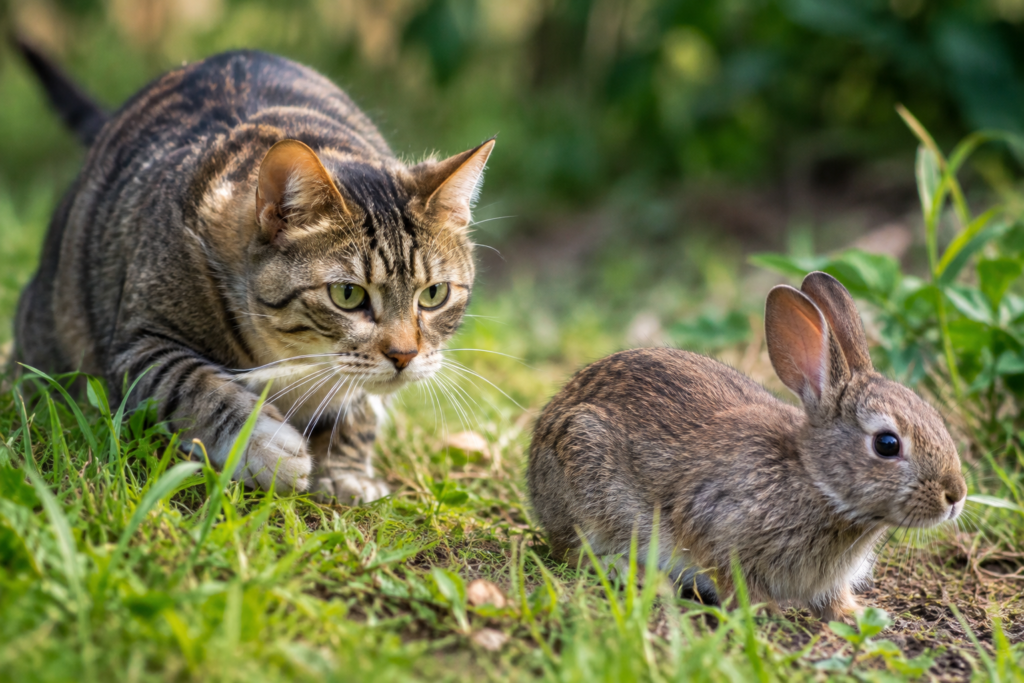

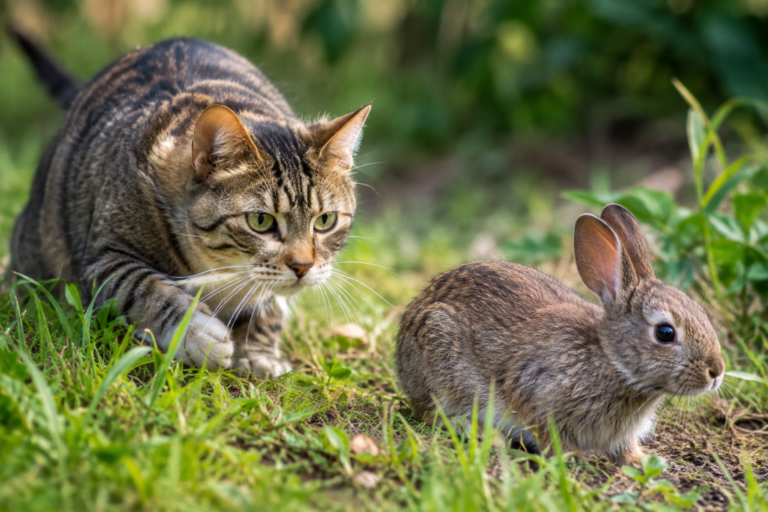
Yes, cats eat rabbits but not every cat that catches a rabbit will eat it. Rabbits are a documented part of the diet of free ranging domestic cats, and wild rabbits can also expose cats to infections such as tularemia.
If your cat has ever chased a rabbit in the yard, brought one home, or eaten part of one, you are probably wondering what this behavior means and whether you should be worried. The answer depends on what happened, whether the rabbit was wild or a pet, and whether your cat actually consumed any of it.
Do Cats Eat Rabbits?
Yes. cats can hunt and eat rabbits and may eat them when they have the opportunity.
This is not just something occasionally seen in a few unusually aggressive cats. Research on the diet of free ranging domestic cats has documented rabbits among the animals cats consume. A large global review examined 533 studies and identified 2,084 species eaten by cats. The European rabbit was one of the most commonly documented prey species, appearing in 114 studies.
That does not mean that 21.39 percent of cats eat rabbits. The 21.39 percent figure refers to the proportion of studies in that research dataset in which European rabbits were recorded as prey. That distinction matters because cat diets vary considerably depending on location, prey availability and the individual cat.
A newer 2026 study of free ranging cats in Dutch open habitats also detected European rabbits among their wild prey. In that study, lagomorphs made up about 5 percent of the diet based on relative read abundance.
So the short answer is simple: yes, rabbits can be prey for cats.
Why Do Cats Hunt Rabbits?
Cats are obligate carnivores. Cornell Feline Health Center explains that cats rely on nutrients found in animal products and evolved as hunters that consume prey containing relatively high amounts of protein and moderate amounts of fat.
That hunting behavior does not disappear simply because a cat now lives in a home and gets meals from a food bowl.
A well fed cat can still stalk, chase and catch small animals. Hunting is part of feline behavior, and research on free ranging cats shows that individual cats can differ in their hunting behavior and the prey they pursue. Prey availability also influences what cats consume in different locations.
This is why a cat that has just eaten dinner can still become intensely interested when a rabbit suddenly appears in the yard.
Can Cats Kill Rabbits?
Yes, a cat can injure or kill a rabbit.
The risk is especially important for young or small rabbits because a cat’s teeth and claws can cause serious injuries. A rabbit does not have to be eaten for an encounter with a cat to become dangerous.
It is also important to remember that hunting and eating are not exactly the same thing. A cat may catch or kill prey without consuming the entire animal. Research into cat diets includes animals that were depredated, scavenged or otherwise consumed, so the scientific evidence does not support treating every hunting encounter as proof that a cat ate the prey.
Do Cats Always Eat the Rabbits They Kill?
No.
Some cats may eat their prey, while others may leave it behind. What a particular cat does can depend on the individual cat, the circumstances and access to other food.
This is one reason the familiar situation of a cat leaving a dead animal outside the house should not automatically be interpreted as unusual behavior.
The important point for owners is that catching a rabbit does not necessarily mean your cat needs to eat it.
Are Rabbits Common Prey for Cats?
They can be.
The strongest evidence comes from the large global review of free ranging domestic cat diets. Researchers found that mammals, birds and reptiles made up about 90 percent of the species recorded in cat diets. The European rabbit was recorded in 114 of the 533 studies that provided species level data.
There is also evidence from individual field studies. For example, research on two suburban cats in New Zealand recorded European rabbits among the animals caught by both cats.
Another study of feral cats and house based domestic cats in southern Sweden found wild rabbits to be an important prey species, with prey use changing according to rabbit abundance and availability.
So rabbits are not simply a theoretical food source for cats. They have been documented as prey in multiple research settings.
What Happens If a Cat Eats a Wild Rabbit?
This is where the situation becomes more important than simply asking whether cats can eat rabbits.
A wild rabbit is not the same as commercially prepared rabbit meat or a complete cat food containing rabbit.
Wild animals can carry infectious organisms, and cats that hunt and eat wildlife can be exposed to them. One disease that deserves particular attention with rabbits is tularemia.
Can a Cat Get Sick From Eating a Rabbit?
Yes, it is possible.
Tularemia is a bacterial disease caused by Francisella tularensis. Merck Veterinary Manual identifies wild rabbits as an important source of infection and says cats can be at increased risk because of their predatory behavior. Cats can become infected by eating an infected carcass or through other routes such as bites from infected ticks, fleas or deer flies.
VCA Animal Hospitals also describes tularemia as an uncommon infection in cats and notes that cats can be exposed when they kill or eat an infected rabbit or rodent.
That does not mean your cat will automatically become sick after eating a rabbit. The concern is exposure to an infected animal, not rabbits being universally dangerous to cats.
What Are the Signs of Tularemia in Cats?
Merck Veterinary Manual reports that some cats may show no signs, while others can become seriously ill. Possible signs include:
- Fever
- Swollen lymph nodes
- Lethargy
- Poor appetite
- Stiffness or reduced movement
- Coughing or increased breathing rate
- Vomiting or diarrhea
- Sores in the mouth or throat
Severe infection can spread to multiple organs, and collapse or death can occur. Early diagnosis and treatment are important.
If your cat has eaten a wild rabbit and then develops signs of illness, contact a veterinarian and mention the rabbit exposure. That detail can be useful when the veterinarian is considering possible causes.
Is Rabbit Meat Safe for Cats?
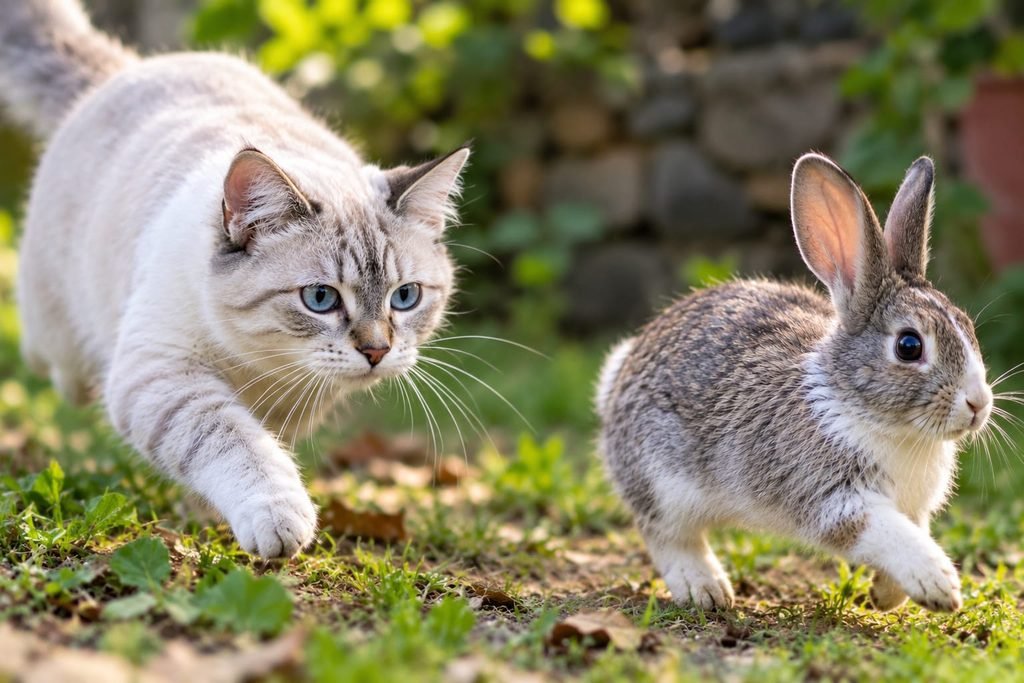
Rabbit meat itself is an animal protein that cats can consume, but there is an important difference between rabbit meat and a complete cat diet.
Cats need a properly balanced supply of essential nutrients. Cornell explains that cats are obligate carnivores and require specific nutrients from animal products.
Research looking specifically at rabbit carcasses for feline diets found that rabbit tissue can provide many essential amino acids, but the researchers also raised concerns about taurine concentrations in rabbit carcasses. Their findings support the need for appropriate formulation and supplementation when whole rabbit is being considered as a diet for cats.
So it would be a mistake to assume that because a cat can naturally eat a rabbit, feeding an unbalanced rabbit based diet is automatically appropriate.
Is a Wild Rabbit the Same as Rabbit Cat Food?
No.
A rabbit caught outdoors is prey. It may have been exposed to pathogens, parasites or environmental contaminants that are not present in a properly manufactured pet food product.
Commercial cat food is formulated differently and is intended to provide the nutrients cats need when fed as directed.
This distinction is easy to miss when researching whether cats eat rabbits, but it is important for cat owners. The fact that cats naturally consume prey does not mean every whole animal is nutritionally complete or medically risk free.
What Should You Do If Your Cat Catches a Rabbit?
First, try to prevent your cat from continuing to eat the rabbit.
If the rabbit is still alive, avoid putting your hands between the cat and rabbit because an excited cat can bite or scratch. The rabbit may also require urgent veterinary or wildlife care depending on the circumstances.
If your cat has already eaten part of a wild rabbit, keep an eye on the cat and pay attention to any changes in appetite, energy or behavior. If illness develops, tell your veterinarian exactly what happened and when the exposure occurred.
You should be especially cautious if the rabbit appeared sick or was found dead before your cat encountered it. Merck notes that infected wildlife carcasses can transmit tularemia to cats through direct contact or ingestion.
Can Cats and Rabbits Live Together?
Sometimes cats and pet rabbits can live in the same household, but that does not mean they should automatically be left together.
A pet rabbit may still be perceived as prey by a cat. Even if a cat has never attacked an animal before, owners should not assume that the two animals will always behave safely around each other.
A secure rabbit enclosure and careful supervision are important when both species are kept in the same home.
The safest approach is to manage the environment rather than relying on the cat to ignore its hunting instincts.
Will a Cat Attack a Pet Rabbit?
It can.
A cat does not necessarily understand that a particular rabbit is a family pet rather than an animal it could chase. The risk can be especially concerning when the rabbit is small, young or unable to escape.
This is why a pet rabbit should have a secure area that the cat cannot enter.
Do not assume that a calm first meeting means the animals can safely be left together without supervision.
How Can You Stop a Cat From Hunting Rabbits?
The most reliable way to reduce hunting opportunities is to control the cat’s access to outdoor prey.
Keeping a cat indoors prevents encounters with wild rabbits. For owners who want their cats to spend time outdoors, secure enclosed spaces can provide outdoor access without allowing unrestricted roaming.
This approach also reduces exposure to other outdoor hazards. Veterinary sources recommend reducing exposure to wildlife and keeping cats confined as part of tularemia prevention.
Providing appropriate play, toys and activities indoors can also give a hunting oriented cat an outlet for stalking and chasing behavior.
If your cat spends time outdoors, you may also want to read our guide on Can House Cats Get Lice? because outdoor exposure can bring other parasite concerns that cat owners should know about.
What If My Cat Keeps Bringing Rabbits Home?
Do not punish your cat for it.
From the cat’s perspective, hunting is normal behavior. Punishment is unlikely to teach the cat that hunting itself is wrong.
Instead, focus on preventing access to rabbits.
If possible, keep the cat indoors or use a secure outdoor enclosure. If your cat is already accustomed to going outside, changing that routine may take some adjustment, but reducing opportunities to hunt is more effective than trying to punish the behavior after it happens.
Frequently Asked Questions
Do cats eat rabbits?
Yes. Cats can hunt and eat rabbits, and rabbits have been documented as prey in studies of free ranging domestic cat diets.
Can cats kill rabbits?
Yes. Cats can injure or kill rabbits, particularly smaller or vulnerable rabbits.
Do cats always eat rabbits after killing them?
No. A cat may catch or kill prey without eating it. Individual hunting and feeding behavior varies.
Can a cat get sick from eating a wild rabbit?
Yes, there is a risk of exposure to infectious diseases. Tularemia is one documented concern because infected rabbits can transmit the bacteria to cats through ingestion or direct contact.
What happens if my cat eats a rabbit?
Your cat may show no immediate problem, but eating a wild rabbit can expose the cat to infectious organisms. Monitor your cat for changes in appetite, energy or health and contact your veterinarian if illness develops. Tell the veterinarian about the rabbit exposure.
Can cats eat rabbit meat?
Cats can consume rabbit as an animal protein, but whole rabbit should not automatically be assumed to be a complete and balanced diet. Research has raised concerns about nutrient adequacy, including taurine, when rabbit carcasses are used as feline diets.
Do cats hunt rabbits even when they are well fed?
Yes, being fed by an owner does not eliminate a cat’s natural hunting behavior. Cats evolved as hunters, and research shows that free ranging cats continue to consume wild prey.
Can cats and rabbits live together?
They can sometimes coexist in the same household, but owners should not assume that unrestricted interaction is safe. A rabbit should have a secure area and interactions should be carefully managed.
Should I worry if my cat brings home a rabbit?
If the rabbit was wild, avoid letting your cat continue eating it. If your cat has consumed part of the rabbit, monitor the cat and contact your veterinarian if any illness develops. Tell the veterinarian about the exposure because infected wildlife can transmit tularemia.
How can I stop my cat from hunting rabbits?
Reducing outdoor roaming is the most direct way to prevent contact with rabbits. Indoor living or a secure enclosed outdoor space can reduce hunting opportunities and wildlife exposure.
So, Do Cats Eat Rabbits?
Yes, cats can eat rabbits. Rabbits are a documented prey species for free ranging domestic cats, and individual cats may hunt, kill or consume them differently.
The bigger issue is what kind of rabbit your cat encountered. A commercially prepared rabbit based cat food is very different from a wild rabbit caught outdoors. Wild prey can expose cats to infectious organisms, including the bacteria that causes tularemia.
If your cat caught or ate a wild rabbit, there is no reason to assume it will automatically become sick. But it is worth taking the exposure seriously, watching for changes in your cat’s health and speaking with your veterinarian if anything seems unusual.
For cats that repeatedly hunt rabbits, preventing access to wildlife is the better long term solution than trying to punish the behavior after the hunt.